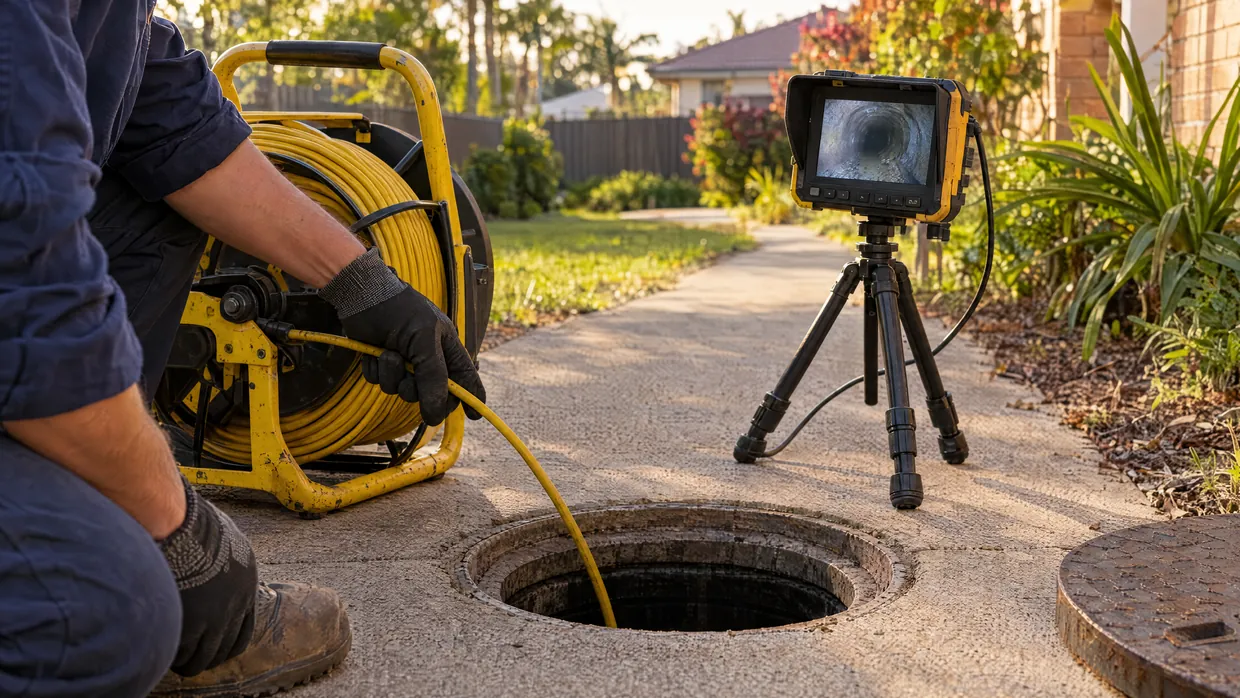
How we find the cause.
We find a suitable access point, feed a camera along the drain and show you what it sees. The footage shows obstructions, root intrusion, cracks, displaced joints and sections holding water. Where it matters, we locate the fault on the surface so the depth and position are known before anyone breaks ground.
A camera finds the problem, it does not fix it. What it does is stop you paying to dig in the wrong place. Heavy build-up or standing water can block the view, so a drain sometimes needs clearing first to be inspected properly. Ask what sections we can reach, and what you will be given at the end.
What this means in Bundamba
The drains under Bundamba homes have been in the ground for many decades, and after the second blockage it is cheaper to look than to keep guessing. A camera shows which it is: roots at an old joint, a collapsed section, a belly holding water or scale build-up. Those four faults look identical from the surface and need four different repairs.
After flooding in Bundamba, a camera can check submerged drains for silt, debris and damage. It is worth doing where flow has never quite returned to normal, because the difference between a silted line and a damaged one decides whether you need a clean or a repair.
Homes in Bundamba have often had sections of drain replaced or extended over the years, sometimes in a different material, and almost never with a record kept. A camera maps what is actually there before anyone quotes a repair, which matters most where earlier work was never documented and the house has changed hands since.
In Bundamba, where historic mine workings sit beneath parts of the suburb, a camera can show displaced joints or a change in fall following ground movement. That is information worth having before you commit to a repair method, because a pipe in ground that is still moving needs a different approach.
Ageing earthenware drains, ground that has moved above old workings in places, and stormwater that depends on creek levels. 84% of occupied homes in Bundamba are separate houses, and 16% are townhouses or apartments — where a blocked drain can involve shared pipework, and the body corporate needs to be in the conversation before anyone books work.
Ipswich City Council publishes historical flood mapping showing the estimated extent of the 1974, 2011 and 2022 floods. If your property is in a low-lying part of Bundamba, that mapping is worth checking, and it helps to mention any flood history in your enquiry. View Council flood mapping ↗
Historic underground coal workings lie beneath parts of Bundamba. The Queensland Government’s abandoned mines program publishes information about former mine areas and any remediation work. Queensland Government: abandoned mines ↗
What to send us
Dig out any previous drain reports, footage or site plans. Tell us which fixtures are affected and point us to any inspection openings you know about. If you want footage or a written summary to show a builder, insurer or another trade, say so up front so we scope it that way.
What actually moves the price
The length of drain, how accessible it is, whether it needs clearing first, and whether you need locating and a written report all change the job. A quick look at one problem section and a full condition survey of a property are different pieces of work, and we price them differently.
Sources: ABS 2021 Census QuickStats: Bundamba · Ipswich City Council flood mapping · Queensland Government abandoned mines information. Distances are straight-line from Redbank Plains. Housing descriptions are general observations, not a survey of any individual property.